
Reliable Loss-In-Weight feeders for precise and efficient material flow
Tamtron designs and supplies weighing, dosing, and conveying equipment and systems for process industries such as metallurgy, battery materials, and chemicals. In addition, we provide installation and commissioning services.
Furthermore, Tamtron offers dosing systems for batch and continuous production lines, as well as equipment and systems for bulk material handling and packaging. We supply Loss-In-Weight (LIW) feeders for a wide range of industries in various capacities, ranging from a few kilograms per hour to over 100 tons per hour.
Key benefits
- Ensure precise and stable mass flow control throughout the process
- Maintain a consistent feed rate even during hopper refill
- Adapt the solution to different materials and capacity requirements
- Integrate dosing seamlessly into the plant automation system
- Improve process efficiency with intelligent and adaptive control
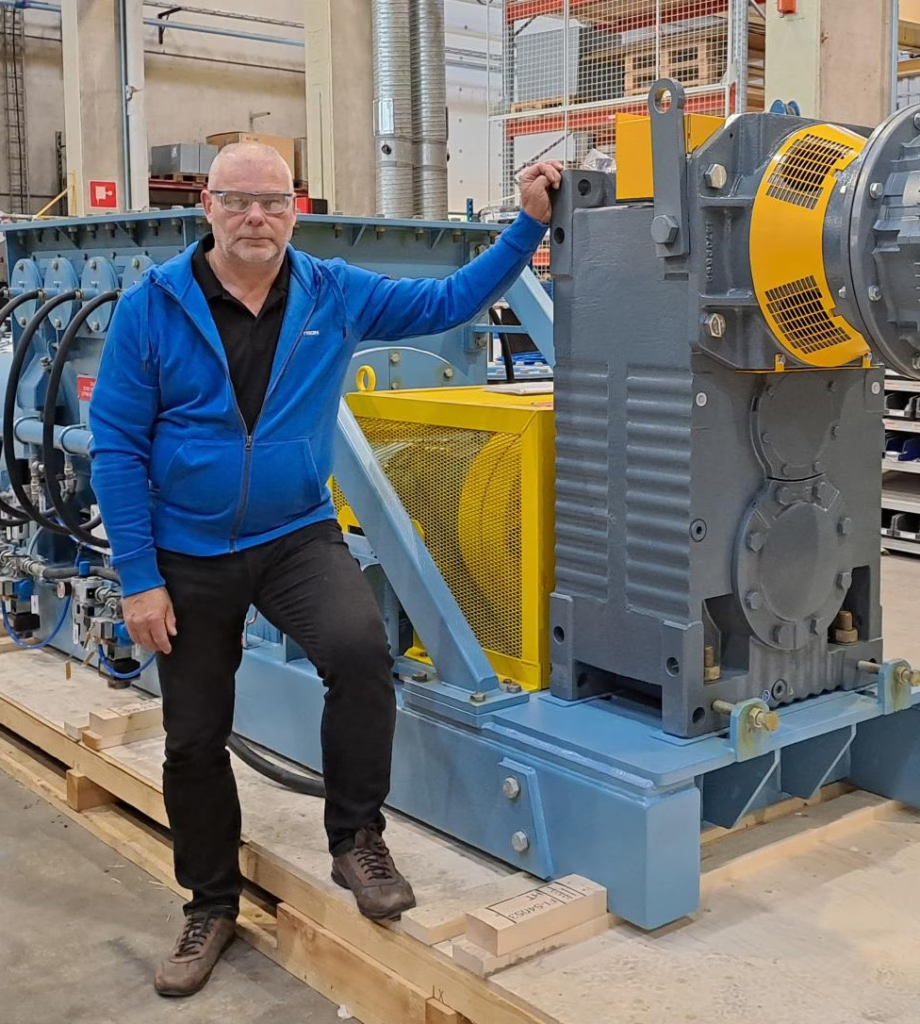
Continuous dosing systems based on Loss-In-Weight feeders
Continuous dosing systems are based on belt feeders or LIW feeders. Dosing systems for batch processes are implemented with silo or hopper weighing and dosing equipment suitable for processing raw materials. System automation typically includes not only the electronics but also the control logic and the user interface. These may all be integrated into a weighing controller for a single feeder, or the feeder may be connected via a fieldbus to the customer’s plant automation system.
The Loss-In-Weight feeder measures and controls
A LIW feeder typically feeds material into the process at a set mass flow rate (kg/h or t/h). The system includes a hopper scale with a feed screw and a vibratory or rotary feeder at the bottom. The LIW weighing controller measures and controls the mass flow to reach the desired feed rate.
The hopper is automatically refilled when its weight falls below the lower limit. The aim is to fill the hopper as quickly as possible, since the feed rate must remain constant during filling. The smart weighing controller can adapt to variations in material properties, thereby improving feeding accuracy.


Frequently asked questions
How is the mass flow set in a Loss-In-Weight feeder?
The controller measures weight loss over time and adjusts the feeding device speed to maintain the desired mass flow (kg/h or t/h).
How are the refill and discharge phases controlled?
When the hopper weight reaches a defined minimum level, the system triggers refilling. During a refill, historical data can be used to stabilise the mass flow.
For what purposes is the LIW feeder suitable?
LIW feeders can be used wherever a continuous, steady flow of material is required. The process itself can be batched or continuous.
Can LIW feeders be integrated into existing automation systems?
Yes. Control can be connected via a fieldbus or integrated directly into plant automation, including data transfer and interface options.
What should be considered when selecting a LIW feeder?
Key factors include material flow properties, density, required throughput (kg/h), refill/discharge cycle, and environmental requirements such as corrosion resistance, ATEX classification, or cleaning needs.
Want to know more?
Contact our experts
Worldwide contact information

Jari Haraholma
Sales Manager, Dosing and weighing systems +358 400 431 550 jari.haraholma@tamtron.comContact us! We’ll figure out the best weighing solution for you.
For local contacts near you, go to:
Contact us
Our success stories
Want to see more?
Go to archive
